


So someone in your network mentioned they’re doing a blended learning data course, and now you’re wondering: what does that actually mean in practice? Is it just a fancy way of saying “online with the occasional Zoom call”, or is there genuinely something different going on?
Good question. The format has evolved a lot, and if you’re considering upskilling in data science or analytics, it’s worth understanding exactly what you’d be signing up for – including the bits people don’t always mention.
What blended learning actually means in a data course
Blended learning combines self-paced online study with live, instructor-led sessions. You’re not just watching pre-recorded videos and hoping for the best. You’re also showing up for real-time classes where you ask questions, work through cases, and interact with fellow students.
The typical rhythm looks like this:
- Before the session: You study materials at your own pace — video lessons, exercises, reading. This is where you build foundational knowledge in tools like Python, SQL, or Power BI.
- During the live session: The instructor goes deeper. You discuss tricky concepts, work on practical cases, and get direct feedback. These sessions aren’t passive — you’re expected to contribute.
- After the session: Assignments, projects, or coding exercises that cement what you’ve just learned.
The blend matters because data skills don’t really stick through passive consumption alone. You need to write the code, break something, fix it, and then explain it to someone else. The live component creates that accountability.
What people actually experience
Reviews from students who’ve completed blended data programmes paint a pretty consistent picture. The initial adjustment is the most common friction point — managing your own schedule for the online portions takes discipline, especially in the first couple of weeks.
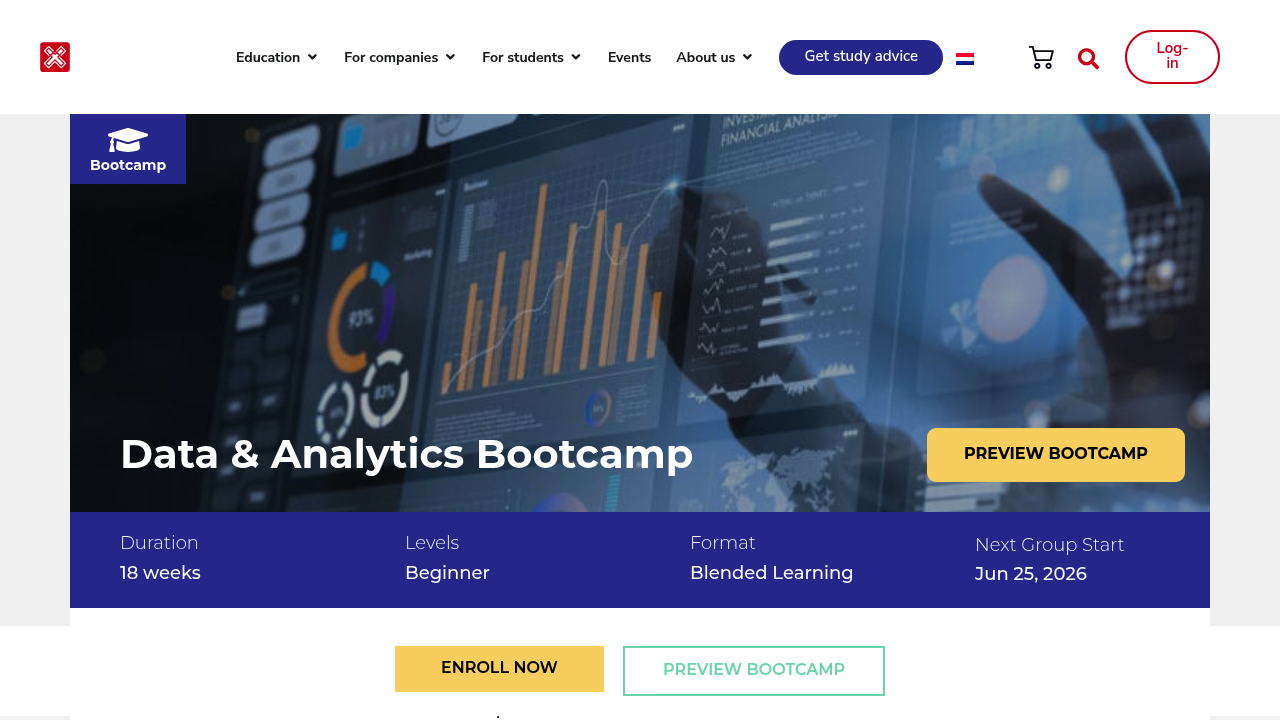
Once people find their rhythm, though, the feedback is largely positive. One graduate of the Amsterdam Data Academy’s Data & Analytics Bootcamp put it well: “The instructor took us on a playful, educational, and effective learning journey… Through a practical case, he provided insight into very technical material in a remarkably simple way.”
Another student noted that even during the course, new opportunities opened up at work: “Thanks to the newly acquired knowledge from the bootcamp, I was able to distinguish myself strongly, and the promotion quickly became a reality for me.”
Those aren’t outliers. A 2025 review published by Academica Mentoring found that blended learning programmes produce 15–20% higher test scores and 25% better knowledge retention after six months compared to traditional instruction. And according to data compiled by Markinstyle, up to 94% of students enrolled in blended learning courses finish them successfully — a completion rate that puts fully self-paced online courses to shame.
The honest trade-offs
Blended learning isn’t perfect for everyone. A few things worth knowing before you commit:
You need to show up. Live sessions have fixed times. If your work schedule is chaotic or you travel frequently, check whether the programme offers recordings of missed sessions. Many do – Amsterdam Data Academy, for example, gives individual-track students access to all class recordings so they can catch up without falling behind.
The online portion requires self-direction. Between sessions, nobody is chasing you. Students who treat the online modules as optional tend to struggle during live classes. The good news is that limited class sizes – a hallmark of quality programmes – mean instructors notice quickly and can step in.
Not all blended courses are built the same. Some providers slap a weekly webinar onto a self-study course and call it blended. The real version integrates both components so they reinforce each other: what you study online feeds directly into what you practise live. Look for programmes where the curriculum is explicitly designed around this flow, not just bolted together.
What to look for when choosing a programme
If you’re based in the Netherlands and looking at blended data education, a few criteria make a real difference:
- Recognised certification – programmes certified by NRTO and CRKBO meet independently verified quality standards. That matters when you’re putting it on your CV.
- Small class sizes – you want to actually interact with the instructor, not be one of 200 people in a Zoom call.
- Practical assignments – the best programmes tie every module to a real task. By the end, you should have a portfolio of work, not just a certificate.
- Optional internship access – some programmes offer a pathway into a real company placement, which is invaluable if you’re switching careers. Amsterdam Data Academy’s bootcamps include this as an optional step, and previous students who took it up report an 80–90% success rate in finding data roles afterwards.
For those just starting out, a fundamentals of data science & AI course is a good way to test whether the format suits you before committing to a full bootcamp.
Is it worth it?
For most people wanting to transition into or advance within data roles: yes. The blended format addresses the two biggest failure modes of solo online learning (no accountability, no feedback) without requiring you to quit your job and sit in a classroom full-time.
The blended learning data science education market was valued at $28.6 billion in 2025 according to Dataintelo’s market report – and it’s growing at 13.5% annually. That growth reflects real demand from working professionals who’ve found it genuinely works.
If you’re still unsure which route fits your situation, the all courses & bootcamps overview is a solid starting point for comparing your options side by side. And if you’d rather talk it through with someone first, improving your AI skills without full-time study covers practical ways to upskill even when life is busy.
The format works. What matters now is finding the programme that fits your goals.
