Data Essentials for Finance Course
A 24-hour course on reading and questioning financial reporting, and on handling data within the GDPR, closing with an assessed final report.
- Duration
- 3 weeks (24 hours)
- Time per week
- 8 hours
Who this is for
This fits you if
- Controllers, finance and administrative staff, and anyone who has to act on management reporting.
Another option may suit you better if
[To be defined]
Prerequisites
- No technical background required.
What you'll learn
- Judge the quality of a data set before you report on it.
- Recognise common reasoning errors in management reporting and forecasting.
- Judge which conclusions a data set does and does not permit.
- Apply GDPR requirements to collecting and retaining data in your own practice.
What you'll learn, module by module
-
1
The quality of your data
Where the numbers come from, what goes wrong on the way in, and how to judge a set before you build on it.
-
2
Reading a report
Which conclusions the numbers support, and the reasoning errors that turn up most often in management reporting and forecasting.
-
3
Data in your own practice
What the GDPR requires when you collect, use and retain personal data.
-
4
Final report
You apply the material to your own practice and are assessed against a rubric, with written feedback.
What a week looks like
The course runs for 3 weeks, and every week looks like this.
8 hours per week
5 hours
Self-study
Course material and exercises on our learning platform, whenever suits you.
1 hour
Live with your teacher
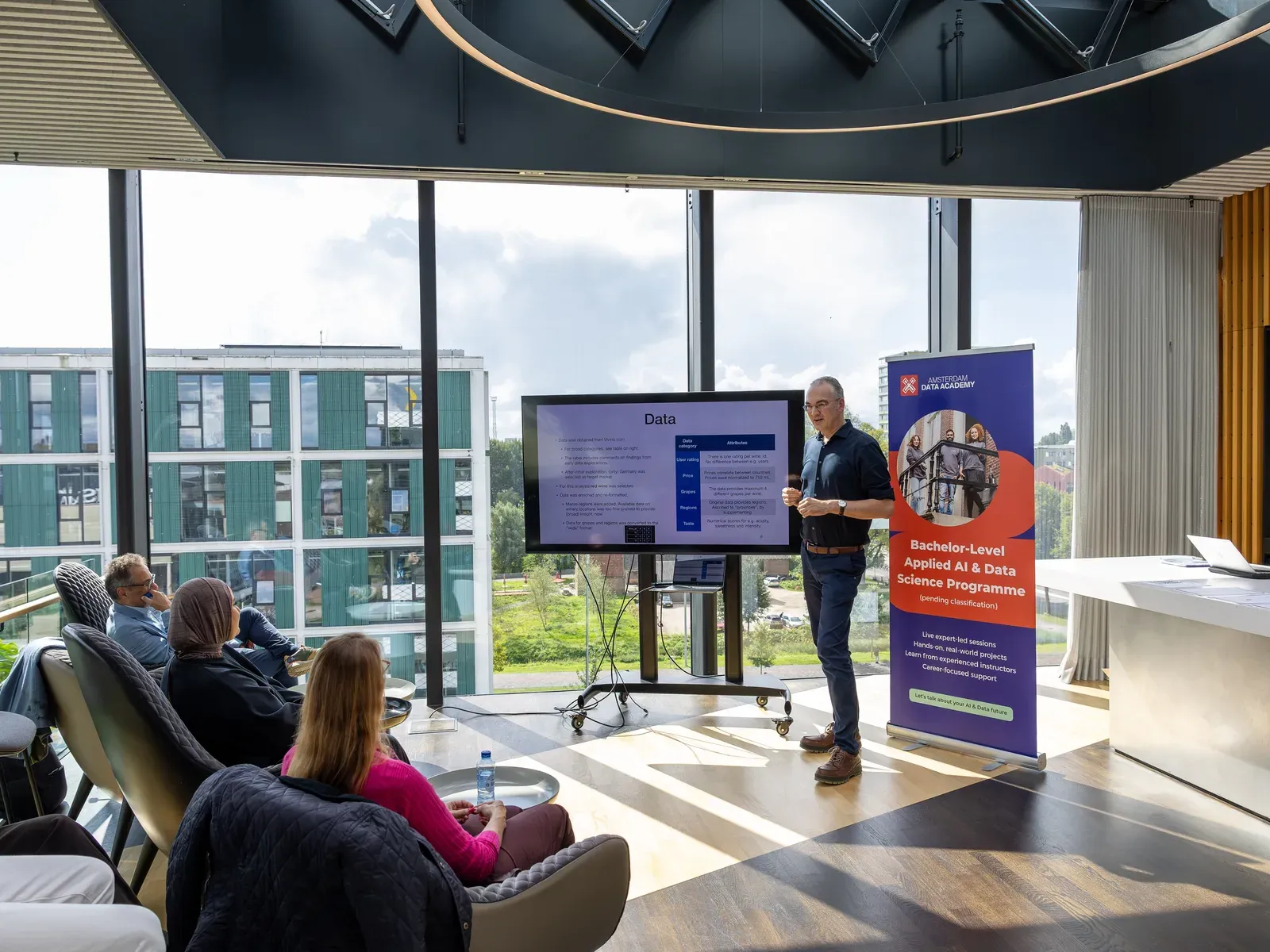
A fixed moment every week, online or at Science Park. Small group, so you get to participate.
2 hours
On your own work
Do the assignment on your own data and your own situation. No exercise files.
Teacher for this course

Patrick Pisani
Data Science, Applied AI & Analytics Education
Patrick is a Data & AI Specialist with an MSc in Data Analytics and extensive experience across finance, tech, and government sectors. Specializing in Python, SQL, and predictive analytics such as e-commerce forecasting models, he guides cohorts through core data engineering, applied statistics, and machine learning principles at Amsterdam Data Academy.
Choose your format
The content, the teacher and the certificate are the same in all three formats. What differs is the focus and the planning, and that's reflected in the price.
With your team
A proposal made for your organisation, from four participants.
- From four participants
- Built around your own cases
- On location or remote
- Subsidy often possible
In a group
The usual way: you share the teacher with a few others and follow a fixed schedule.
- Fixed start date, fixed schedule
- Small group of fellow students
- Shared teacher
Individual
For anyone who prefers to work at their own pace.
- Start whenever you want
- Your own pace and planning
- Teacher just for you
- Personal guidance
Every course counts: your certificate states it is part of our programme at NLQF Level 6, comparable to bachelor level. What NLQF Level 6 means →
Flexible payment
Payment options
Through your employer, with a voucher or in instalments: there's usually a way that works. Not sure which fits you? We're happy to think it through with you, free and without obligation.
Option 1
Through your employer
We can invoice your employer directly, with 30 days to pay. If it helps, we'll give you a training plan to discuss internally.
Option 2
With a government contribution
A UWV training voucher or a municipal voucher can cover (part of) the cost. We're on the approved lists, CRKBO-registered, and glad to help with the application.
Training with colleagues? Your employer may be able to use the SLIM subsidy; we're happy to do the application together.
Option 3
Paying yourself
Pay the full amount at once, or spread it: 3 or 5 instalments at no extra cost, or an interest-free loan through TechMeUp. You choose when you register.

Officially classified
NLQF Level 6, comparable to bachelor level
Every course and bootcamp is part of our Applied AI & Data Science programme, classified by NCP NLQF at NLQF Level 6, comparable to bachelor level. Your certificate states it, so employers know what your training is worth.
What NLQF Level 6 means →