Why AI adoption stalls: what 80 leaders told us in Amsterdam
4 September 2026
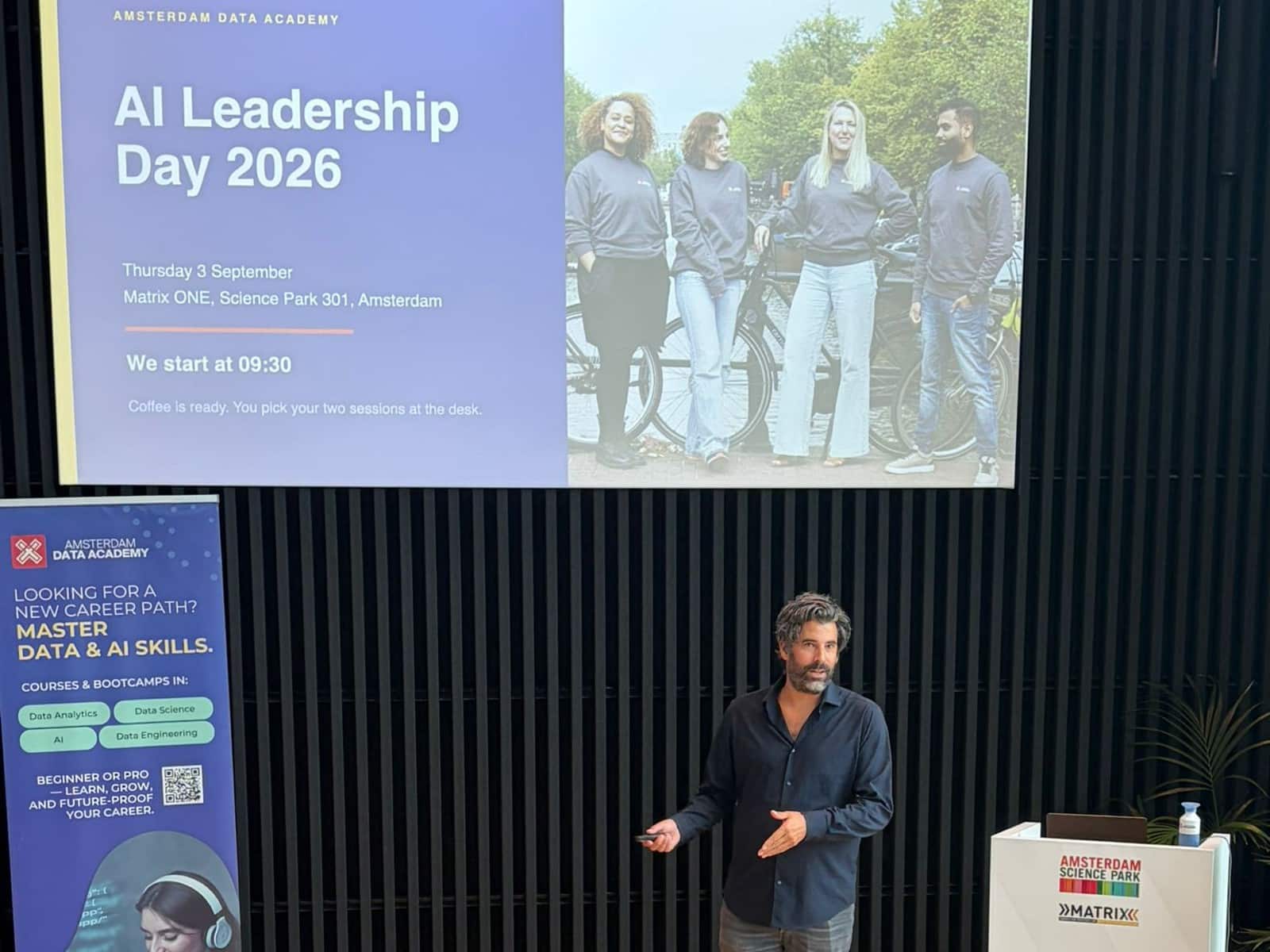
On 3 September we put 80 founders, directors and senior leaders in one room at Matrix ONE on Science Park. Invite only, sold out, with 10 speakers. 3 keynotes, 6 parallel sessions and a panel. The question we came to answer: why do so many AI programmes stall?
Our own research keeps returning the same 2 numbers.
87 percent expect AI to change or replace existing roles, and 84 percent describe upskilling as urgent. Wanting and doing are not the same thing, and the distance between them is where most AI programmes quietly stall. This is what came out of the day.
The bottleneck is not the technology
 Marlene de Koning, Director Workforce Transformation at PwC, opened with a line that people were still repeating at the drinks.
In a race to automate everything, the most radical act is knowing what not to automate.
— Marlene de Koning, PwC
Her argument was uncomfortable in a useful way. AI capability is advancing faster than at any point in the last 70 years, and most companies have still not seen a financial return. If capability is not the constraint, something else is. She named 4 conditions that decide whether adoption scales or stalls.
- Value. People can see how AI helps their actual work, not the work described in a strategy deck.
- Trust. People feel safe, informed and accountable when they use it.
- Capability. People have the skill and the judgement to use it well.
- Leadership. Leaders model it, prioritise it, and redesign work around it.
Weakness in any one of them is enough. High value with low trust means people see the opportunity and avoid the risk. High trust with low capability means willing but ineffective. High capability with weak leadership means innovation stays trapped in pockets. Strong leadership with unclear value means adoption feels pushed rather than pulled.
Executives talk about productivity, cost and scalable intelligence. Employees ask which task this improves, whether it is easier than what they do now, and who is accountable when it goes wrong. Those are not the same conversation. Her keynote drew on PwC and the World Economic Forum on AI and productivity.
Slides: Marlene de Koning · Watch the keynote
The question underneath all of it
 Maarten de Rijke, Distinguished University Professor at the University of Amsterdam and Scientific Director of ICAI, reframed the whole thing as a question about reliance.
At what point does an AI capability become something an organisation, or a person, is willing to rely on? And what has to happen between now and then?
— Maarten de Rijke, University of Amsterdam
That is a harder question than “does it work”, and it is the one that decides budgets. Reliance is earned through testing and evaluation, not through demos. It is also why the gap between a promising pilot and a system anyone will stake a process on is measured in months of unglamorous work rather than in model releases.
Slides: Maarten de Rijke · Watch the keynote
Bringing the organisation with you
 The third keynote, after lunch, was Bo Vialle-Derksen of Deloitte on what actually moves an organisation. Not the tooling and not the strategy document, but the daily work of the people who have to do something differently on Monday, and the leaders who have to make that worth their while.
It landed in the room because it was the first time that afternoon that somebody talked about resistance as information rather than as an obstacle.
Slides: Bo Vialle-Derksen · Watch the keynote
3 questions, 6 sessions
Around the keynotes the day was built on 3 questions that every leader in the room was dealing with in some form. 2 rounds, 3 parallel sessions each, and every session had to answer one of them.
How do you use AI safely?
 Laurens Schumacher, Deloitte
Building AI Systems That Work: how to get a PoC to actually bring value
He walked through building AI systems in practice, with cases from Deloitte’s own work, and the number he opened with stuck with the room: 95 percent of AI pilots never make it to production. His point was that the failure is almost never the model. It is the absence of an owner, a data pipeline anyone trusts, and a decision about what the system is allowed to do on its own.
 Alessandro Vozza, Volt Datacenters
Beyond the Clouds: sovereign AI infrastructure
The AI Architect at Volt argued for sovereign infrastructure as a way to regain control and autonomy, rather than as a compliance exercise. It turned into the most technical and the most political discussion of the day, because it forced the question of what you actually own when your models, your data and your compute all sit somewhere else.
How do you keep it controlled?
 Arthur Vankan, Dialogic
AI is a gamechanger, now for the rules of the game
AI has already changed the game, and the rules are what is being rewritten right now. He took the room through impact assessments, IAMA and FRAIA, and the question that sits underneath all of them: who signs off, on what, and on the basis of which evidence. He also recorded an episode of our podcast on the same theme.
 Ishan Singh, Uber
From experimentation to adoption
Scaling AI in a controlled way at the size Uber operates at, including the part that surprised people most: using AI to keep AI in check. Evaluation, monitoring and guardrails as a product in their own right, not as a checklist at the end.
How do you bring people along?
 Marloes Roelands, AIC4NL
Design learning for the future of work
On developing professionals in the age of AI, with an argument that landed uncomfortably close to home for a room full of employers: learning is not keeping up with the technology. Not because people are unwilling, but because the way we organise training still assumes a stable job description.
 Joris Merks, leadership trainer, formerly Google
Leading with AI: build high performance teams
On leading with AI and building teams that use it as a sparring partner rather than as a shortcut. The distinction matters more than it sounds: a team that uses AI to think faster gets better, a team that uses it to think less gets worse, and from the outside the two look identical for quite a while.
The argument in the panel
The panel is where it got interesting, because the room did not agree. Marloes Roelands, Joris Merks and Rob Stroober, chair of our examination board, took it on.
One side: AI adoption is a top-down decision. Somebody has to set the direction, free the budget, and accept the risk, and without that you get enthusiasm and no change. The other side: the useful applications are found by the people doing the work, and every attempt to design adoption centrally produces compliance rather than adoption.
Both are right, which is the problem, and that is the funny part: the answer is not one of the two but the combination. The organisations that get somewhere seem to do both deliberately: direction and permission from the top, applications and evidence from the bottom, and a middle layer that is equipped to connect the two rather than absorbing the pressure from both sides.
That middle layer came up repeatedly, and it is the group almost nobody is training.
What we took away
The technology question is largely settled for this group. Everyone in the room had tools, pilots and budget. What almost nobody had was a clear answer to who decides, who signs, who has to work differently, and what happens when they refuse.
That matches what our research has been showing since 2024. Data literacy remains the foundation, and it is still missing. Plenty of professionals are using generative AI daily without a working understanding of what the systems do, which makes it very hard to judge when to trust the output and when not to.
69 percent want to invest. 20 percent are in training. Closing that gap is not a technology project.
Watch it back
The day in 2 minutes.
And the opening of the day, on why it exists and the 3 questions running through it.
Watch the opening · Our YouTube channel
The podcast
We recorded 6 episodes on the day itself, in the room next to the auditorium, with people who were there. They go into De Amsterdam Data Academy Podcast, open conversations about AI in practice: what works, what does not, and how to go about it responsibly.
Listen on Spotify · Watch on YouTube
All the slides
- Olivier van Hees, Amsterdam Data Academy. Opening: why this day exists, and the 3 questions running through it. Slides Recording
- Maarten de Rijke, University of Amsterdam. Keynote. From Neurons to Public-Private Labs: how testing and evaluation determine AI adoption. Slides Recording
- Marlene de Koning, PwC. Keynote. Leading the organisation in the Age of Agentic AI. The research behind it: AI and productivity and Beyond technology. Slides Recording
- Bo Vialle-Derksen, Deloitte. Keynote. Change and adoption in the age of AI. Slides Recording
- Laurens Schumacher, Deloitte. Session. Building AI Systems That Work: how to get a PoC to actually bring value. Slides
- Arthur Vankan, Dialogic. Session. AI is a gamechanger, now for the rules of the game. Slides Podcast
- Marloes Roelands, AIC4NL. Session and panel. Design learning for the future of work. Slides
- Alessandro Vozza, Volt Datacenters. Session. Beyond the Clouds: sovereign AI infrastructure. Slides
- Ishan Singh, Uber. Session. From experimentation to adoption. Slides
- Joris Merks, leadership trainer, formerly Google. Session and panel. Leading with AI: build high performance teams. Slides
- Rob Stroober, chair of the ADA examination board. Panel. No slides.
What comes next
At the end of the day we announced the AI Leadership Track, a closed programme for 8 founders, directors and senior leaders running from 27 October 2026 to 12 February 2027.
It is deliberately small. You bring 1 real AI decision from your own organisation and you keep it for the whole programme. An online kickoff, 3 Friday afternoons in Amsterdam on technology choices, governance and adoption, 3 short check-ins in between, and a closing afternoon in February where you present your plan and 7 peers try to break it.
8 seats. Applications close 16 October 2026. Attendees of the AI Leadership Day have priority.
Amsterdam Data Academy trains people and teams in data and AI, from short courses to a 2 year diploma programme classified at NLQF Level 6, comparable to bachelor level. We are CRKBO and NRTO registered.